
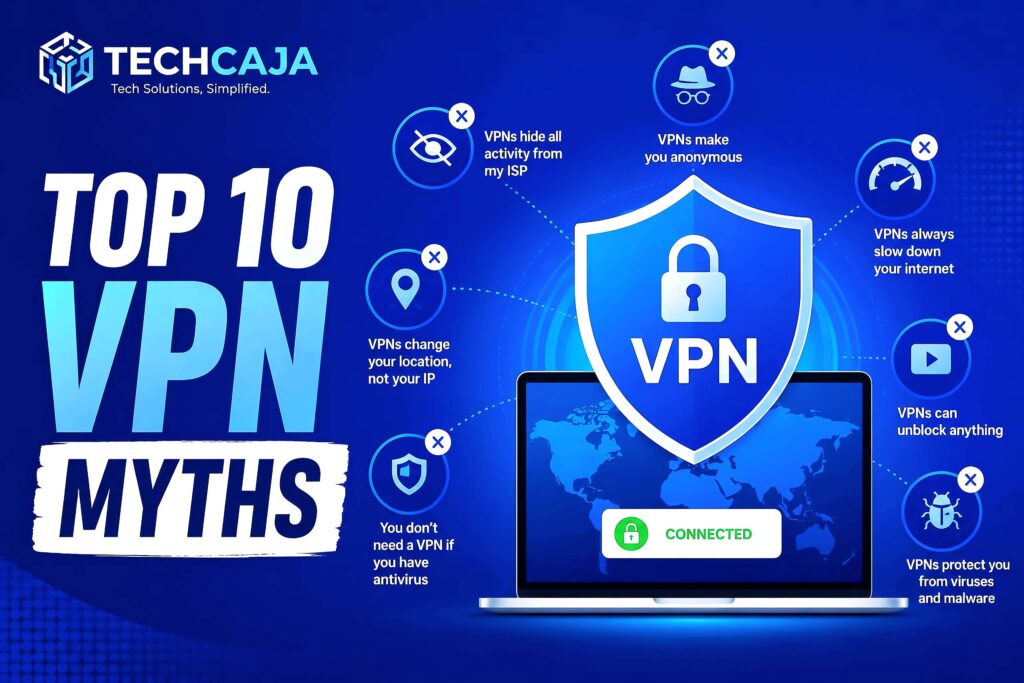
In today’s online world, millions of people use a VPN every day. A VPN (Virtual Private Network) is a simple tool that hides your real IP address and scrambles your internet data so others cannot easily see what you do online. It protects your privacy on public Wi-Fi, helps you access content from other countries, and stops your internet provider from tracking your activity.
But many wrong ideas about VPNs still exist. These myths make people avoid VPNs or choose bad ones that do not help. Some believe VPNs are only for experts or that they are illegal. Others think free VPNs work just as well as paid ones. In this detailed guide, we bust the top 10 common VPN myths with clear facts. We use simple English so everyone can understand. By the end, you will know the real story and how to stay safer online.
Myth 1: VPNs Are Illegal to Use
Many people think using a VPN is against the law. This is not true in most countries. VPNs are legal in the United States, United Kingdom, Canada, Nigeria, and many other places. Some countries like China only allow approved VPNs, but normal use is still okay in most of the world.
The truth is simple: a VPN is a legal privacy tool, just like wearing sunglasses or closing your curtains at home. What you do online still needs to follow the law. If something is illegal without a VPN, it stays illegal with one. Always check your local rules, but for most users, a VPN is completely fine and smart to use.
Myth 2: I Don’t Need a VPN Because I Have Nothing to Hide
This is one of the most popular myths. People say, “I only check email and watch videos, so why bother?” The problem is that everyone has something to protect. Your internet provider can see every website you visit and may sell that information to advertisers. Hackers on public Wi-Fi can try to steal your passwords or banking details.
Even at home, your data can be used for price discrimination — companies charge you more because they know your habits. A good VPN stops this tracking, hides your location, and adds strong encryption. Privacy is not just for people with secrets. It is for everyone who values safety and control over their own information.
Myth 3: VPNs Make You 100% Anonymous Online
A VPN hides your IP address and encrypts your traffic, which is very helpful. But it does not make you completely invisible. If you log into your Google account, Facebook, or email, those sites still know it is you. Browser fingerprints, cookies, and the way you type can still identify you.
No tool gives 100% anonymity. A VPN is excellent for hiding your activity from your ISP and from people on the same network, but you still need to be careful with what you share online. For most everyday users, this level of protection is more than enough.
Myth 4: Free VPNs Are Just as Good as Paid Ones
This myth can cost you money and privacy. Free VPNs look attractive because they cost nothing. In reality, many free services limit your speed and data, show lots of ads, or — worse — sell your browsing history to make money.
Some free VPNs have even been caught with malware or weak encryption. Paid VPNs from trusted companies offer fast speeds, no-logs policies (checked by independent auditors), strong encryption, and extra features like kill switches that stop your internet if the VPN drops. For a small monthly fee, you get real protection instead of hidden risks.
Myth 5: VPNs Make Your Internet Too Slow
Many people avoid VPNs because they fear slow loading times. In the past this was sometimes true, but not anymore in 2026. Modern VPNs use fast protocols like WireGuard or Lightway that keep speed loss very small — often just 10-30% or less when you connect to a nearby server.
Good providers have thousands of servers around the world, so you can pick one close to you. For streaming, gaming, or normal browsing, the difference is usually hard to notice. If speed matters to you, choose a premium VPN and test it with a money-back guarantee.
Myth 6: VPNs Are Only for Tech Experts or Illegal Activities
Some think VPNs are complicated or only used by hackers and criminals. This is wrong. Today’s VPN apps are super easy. You download the app, tap one big button to connect, and you are protected. No technical skills needed.
Most people use VPNs for normal things like watching shows from other countries, protecting work emails on the road, or keeping family browsing private. Using a VPN does not mean you are doing something bad — it means you care about your privacy.
Myth 7: VPNs Protect You from All Online Threats Like Malware
A VPN is great for privacy and encryption, but it is not a full security shield. It does not stop viruses, phishing emails, or bad links. If you click a dangerous attachment, a VPN cannot block the malware.
Think of a VPN as a secure tunnel for your data. You still need good antivirus software, strong passwords, and common sense. The best protection comes when you combine a reliable VPN with other safe habits.
Myth 8: You Only Need a VPN on Public Wi-Fi
Public Wi-Fi at cafes, airports, or hotels can be risky, so many people only turn on their VPN there. But your home connection is not always safe either. Your ISP can still see and log your activity. Neighbors or advanced attackers might try to spy in some cases.
Using a VPN at home helps with streaming, avoiding bandwidth throttling, and keeping your full browsing history private. It is smart to keep your VPN on most of the time, not just when you leave the house.
Myth 9: All VPNs Are the Same
This is a big mistake. Not every VPN offers the same quality. Some have weak encryption, keep logs of your activity, or have few server locations. Others are independently audited, offer fast global servers, allow many devices at once, and include extra tools like ad and tracker blockers.
Always look for trusted providers with clear no-logs policies, good reviews, and transparent privacy practices. Read recent tests and choose one that fits your needs — whether for streaming, privacy, or travel.
Myth 10: VPNs Are Unnecessary at Home or for Normal Users
Some believe VPNs are only useful when traveling. In 2026, this is outdated thinking. At home you still face ISP tracking, targeted ads, and potential data leaks. A VPN helps you access better prices, watch international content, and work securely from anywhere.
Normal users benefit every day — students researching, families streaming, and professionals handling sensitive files. A VPN has become a basic tool for safe internet use, just like a lock on your front door.
Conclusion
We have now cleared up the top 10 VPN myths. VPNs are legal, easy to use, and helpful for everyday people who want privacy and security. They do not make you invisible or stop every threat, but they give strong protection that is hard to get any other way.
Free options often come with hidden costs to your privacy. Paid VPNs from reputable companies deliver real value with fast speeds and honest policies. In 2026, online threats and tracking are growing. A good VPN is one of the smartest and simplest steps you can take to stay safer.
Take time to pick a trusted VPN. Many offer free trials or money-back guarantees so you can test them risk-free. Turn it on, stay protected, and enjoy the internet with more peace of mind. Your data belongs to you — keep it that way.
If you have questions about VPNs or need help choosing one, feel free to ask in the comments. Stay safe online!
